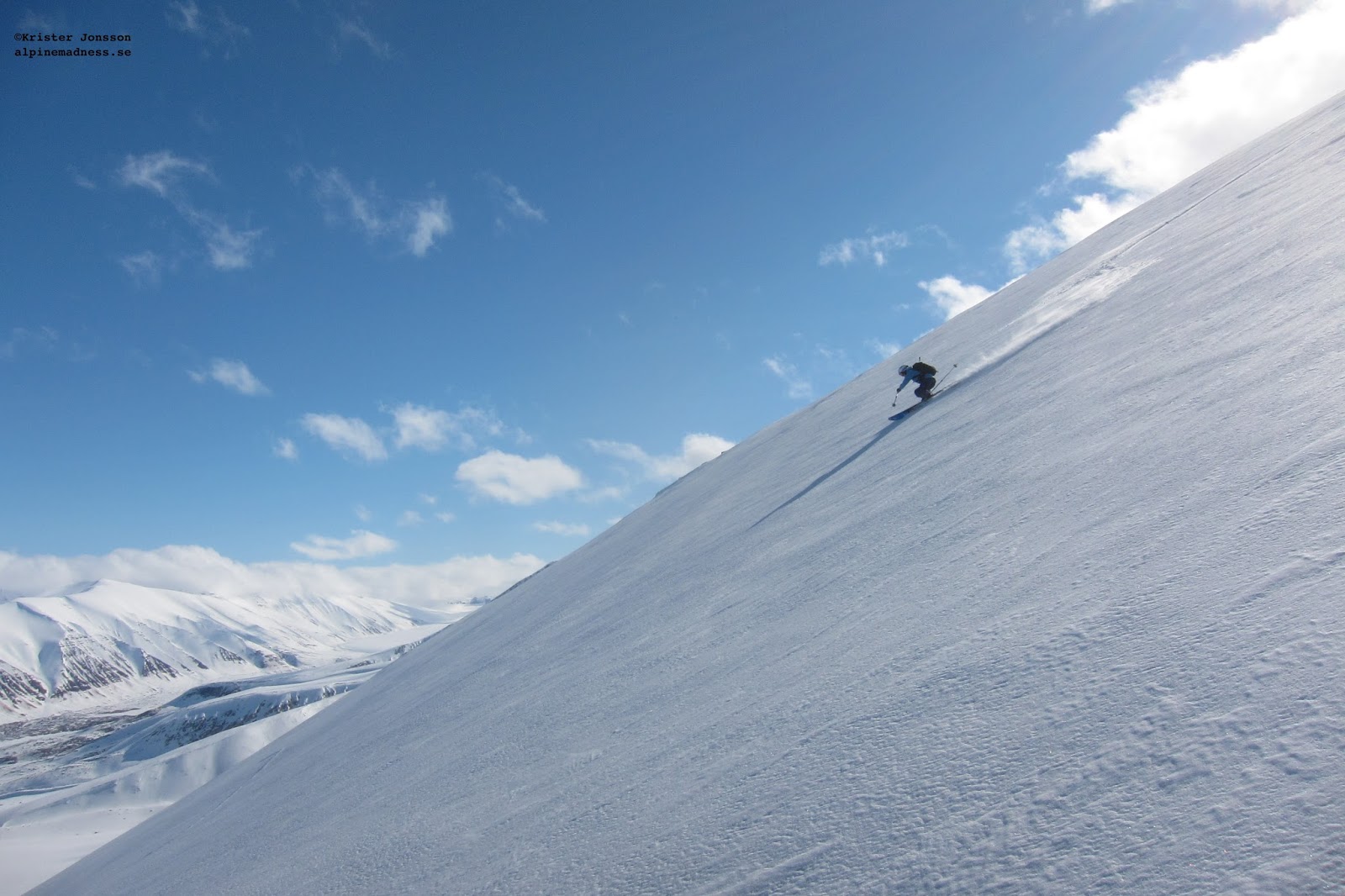
The ultimate ski tour, skiing in the Artic, up to the 80 latitude. In an environment that beats the most.
A number of peaks that never has been skied before. Plan the trip around May / June and there is light the whole day, with the mystic of the midnight sun. Sum that up with a wildlife that is not to be found anywhere else together with the only communication that is via Sat phone. Could it be better!?
After a long season on skis I had the opportunity to make it even longer. 3 weeks of skiing on Svalbard, with the base on the cruise ship Origo. With its excellent Crew.
Well, its an option not to be missed.
Bags packed and with my ski boots in hand I checked in on the flight towards Longyearbyen via Oslo and Tromsö.
Equipped for an Artic ski day - powder and gun
Longyearbyen is located far north, at 78 Latitude, 78° 13′ 3.79″ N, 15° 38′ 15.39″ E. The only thing that is left is the North pole.
Svalbard is sometimes referred to as Spetsbergen, which is one of its bigger islands. It is administrated by the Kingdom of Norway and a demilitarised and a free economic zone.
Sweden got the question to run the administration but we thought that it could be done by the Norwegians. Well they apparently can but what a stupid thing to say no to!!
Anyhow, upon arriving in Longyearbyen I meet up with Anders and Martin and we head to the ship to leave the gear before a trip in to ”town”. Longyearbyen holds about 2000 habitants and on whole Svalbard its about 2600.
The center is quickly cruised but there is a couple of good coffee places. So a well deserved espresso before the real cruise starts. Heading even further north, yes!
Keep Svalbard clean! Collection rubbish from the shore
The first evening we make a stop at Magdalena fjorden, a couple of hours north with Origo. Well protected from the winds and waves. The only issue I could see for this trip, how would the body keep up with the waves and seasickness…!?
Par ici ca va bien…
Added to the normal skiing equipment as avalanche gear and other obvious things is a couple of things one must have while skiing on Svalbard. One is sat phone and rescue sender togheter with a proper radio because lack of other communications. And the other is Shoot gun and a flare gun because the risk of meeting a polar bear.
So you need to have a licens to use a gun and know how to use the weapons. After testing all these things we make a short tour just up the closest slopes to get the legs and mind a little fresh and some appetite before dinner.
In the most excellent light from the midnight sun. Great to be out there, finally.
There is a number of fjords to explore on Svalbard, the only thing is to decide if its best to go south or north. Really just decided on the ice conditions, we decide to sail north.
Anchor up and during dinner we sail under a cloudless sky, no stars visible because the sun shine as bright as ever, as the clock shows 10 p.m.
Walrus gathering...
The wildlife is stunning as well as anything else. There is seabirds following us the whole time. And soon we can spot the first Walrus, a huge animal that can weight up to 2000kg. This animal can be up to 30 years old and dive up to 80m. Staying under surface for up to 30minutes. Its main diet is benthic bivalve mollusks. But it also eats shrimps and crabs. And occasionally seals and Narwhales. Once close to being out hunted because of its skin and speck and meat and the tusks. Now they are slowly recovering but still its not obvious to spot any.
The other hyped-up spice is the Polar Bear. By a good reason, its one of the biggest and most feared predators on earth. A male can weight up to 800kg.
Every morning we start the day with scanning of the surroundings with binoculars to see what activities are going on.
 One such thing to take in mind is seals on the ice, it could mean polar bear around as well.
And scanning the shore it doesn’t take long until we can see the first one, a big yellow/white male. That is keeping watch close to a whole in the ice. And then we spot an other bear, about 500m away from us.
To get a better look we go inte the Zodiaks and watch them from a safe distance. Amazed to watch them as they work togheter to catch the seal that they are waiting to show up to get a mouth of air.
Bear watch from deck
Next stop is Klincowsfjorden. From were we are planning to make a traverse over to Liefdefjorden.
A full day which will give us some 2500 vertical meters of skiing.
Once again we load the boats and steam out on yet an other days of skiing. 10 days and we haven't seen any other around.
During the 10min passage in the Zodiak a big Minke whale appears in front of us. On its hunt for shrimps. A 4-5 ton big "fish" that can be up to 60 years old.
Since there is a fjell named ”Ben Nevis” I just have to go via that peak! One of the reason it has the same name as its "brother" in Scotland might be that they have the same hight
There is a number of familiar places and names. At st Johnsfjorden there is Jämtland and Bydalsfjellet as an example.
Since the Polar bear is a curious animal I tell the others in the group to keep the voices down and make things quick as we prepare for the trip.
-If they get the smell from us it will only take some minutes to cross the fjord, I say as a joke. But with some seriousness behind.
And soon we are starting the ascent upwards Nevis.
After some 15min I hold the group and decide to take a watch as Origo steams out and around the island to meet up on the other side.
During the morning I had observed a bear on the other side of the fjord and I was curios to see were we had her at this time.
-I wonder where…
Following the tracks I can see that she has gone into the water. But then come up again and actually taking a shortcut towards us. Since we are some 500m uphill there is no risk that she will catch up, but still. And when I finally find her she is some 400meters away circulating with her nose trying to get an idea of what we are.
Soon she decides that we are no seals and turns around heading back to the ice again.
We can relax and go on…
Cruising down Ben Nevis...
Having an incident with a Polar Bear is quite unusual and during the last years there has only been a couple of fatal accidents the last years. But, by law you must always carry a rifle outside Longyearbyen. And in this case, it felt quite good to have it!
Julia on Top!
Untouched snow, first tracks again...
On the cruise back towards Longyearbyen we make a stop at the most odd place of ”Pyramiden”.
An old Russian settlement that until 1998 was fully run with 1200 people living there.
In Pyramiden you could find everything from School to hospital, swimming hall, a big exercise gym and bandy rink.
The people who lived there worked in the mines and it was hold as one of the best places to work at in former Soviet union.
The Russians bought Pyramiden from Sweden in 1927, who founded it in 1910.
They still run a mine in Barentsburg which today still have a community of people who lives there.
In Pyramiden the Russians only have a few people that keeps the place housed, between 2-6 persons.
Then in January -98 came a message from Russia.
-The mine is about to close, there will be a ship that picks you up tomorrow.
Now everything is just abandoned, still owned by the mine company Trust Arktikugol. 2013 they opened the Hotel Tulip. So now its possible to stay overnight or even make a season in Pyramiden as a ski bum!
Here you will find the northern most Grand Piano, Red October and of course a Lenin byst.
 |
| The Hotel bar at Pyramiden - Tulip |
 |
| Beer time at Ny-Ålesund |
Barentsburg. An other Russian, but still running, settlement on Svalbard
New and old style
Abandoned houses at Barentsburg
Once back in town again after a number of great ski descents, resulting in some new never skied runs.
During the trip we saw 9 Polar bears, a number of whales and a huge amount of different seabirds and Seals. And about 50 Walrus.
I finish the trip were I started it, at the coffee shop with a fresh espresso. Already planning my next trip to this great place…

Facts:
Svalbard (formerly known by its
Dutch name
Spitsbergen) is a
Norwegian archipelago in the
Arctic Ocean. Situated north of
mainland Europe, it is about midway between continental Norway and the
North Pole. The islands of the group range from
74° to
81° north latitude, and from
10° to
35° east longitude. The largest island is
Spitsbergen, followed by
Nordaustlandet and
Edgeøya.
Administratively, the archipelago is not part of any
Norwegian county, but rather forms an
unincorporated area administered by a state-appointed
governor. Since 2002, Svalbard's main settlement,
Longyearbyen, has had an
elected local government, somewhat similar to
mainland municipalities. Other settlements include the Russian mining community of
Barentsburg, the research station of
Ny-Ålesund, and the mining outpost of
Sveagruva. Svalbard is the northernmost settlement in the world with a permanent civilian population. Other settlements are farther north, but are populated only by rotating groups of researchers; e.g.
Alert, Nunavut—the northernmost year-round community.
The islands were first taken into use as a
whaling base in the 17th and 18th centuries, after which they were abandoned.
Coal miningstarted at the beginning of the 20th century, and several permanent communities were established. The
Svalbard Treaty of 1920 recognizes Norwegian
sovereignty, and the 1925
Svalbard Act made Svalbard a full part of the Kingdom of Norway. They also established Svalbard as a
free economic zone and a
demilitarized zone. The Norwegian
Store Norske and the Russian
Arktikugol remain the only mining companies in place. Research and tourism have become important supplementary industries, with the
University Centre in Svalbard(UNIS) and the
Svalbard Global Seed Vault playing critical roles. No roads connect the settlements; instead
snowmobiles, aircraft and boats serve inter-community transport.
Svalbard Airport, Longyear serves as the main gateway.


The retreat of the ice
60% of Svalbard is currently covered by ice year-round—but for how long?
On the west coast of Svalbard, the glaciers are retreating at the rate of nearly 100 feet per year—and Svalbard is just the most visible victim of the great Arctic melt.
True, some of the ice melts in the summer and freezes back again in the winter naturally all across the Arctic. The problem is that global climate change has pushed the cycle out of balance. Every year, more and more ice melts—and less and less returns in ever thinner ice sheets.
According to the Arctic Council, average temperatures in the Arctic have risen at almost twice the rate as the rest of the world over the past few decades.
In 2007, the Arctic melt broke all records, with 463,322 square miles of ice simply vanishing. That's an area bigger than Texas and California combined. If we keep this up, sometime in the next 20 to 50 years, the Arctic will be completely ice-free in the summertime.
This is not just an inconvenience (by which I mean "near-certain extinction") for polar bears, who already have a rough time hunting on the thinning pancake ice (they can lose up to half their body weight during the summer).
Let's put it this way:
• If all the glaciers in the Alps melt, global sea levels would rise by less than 1mm.
• If all of the rest of the sub-Arctic glaciers (beside Greenland) melt, the seas will rise about 1.5 feet.
• If Greenland melts, the sea levels will rise 20 feet.
• If all the ice in the Arctic melts, global sea levels will rise 197 feet.
//The trouble with normal is that it always tend to get worse